
Description
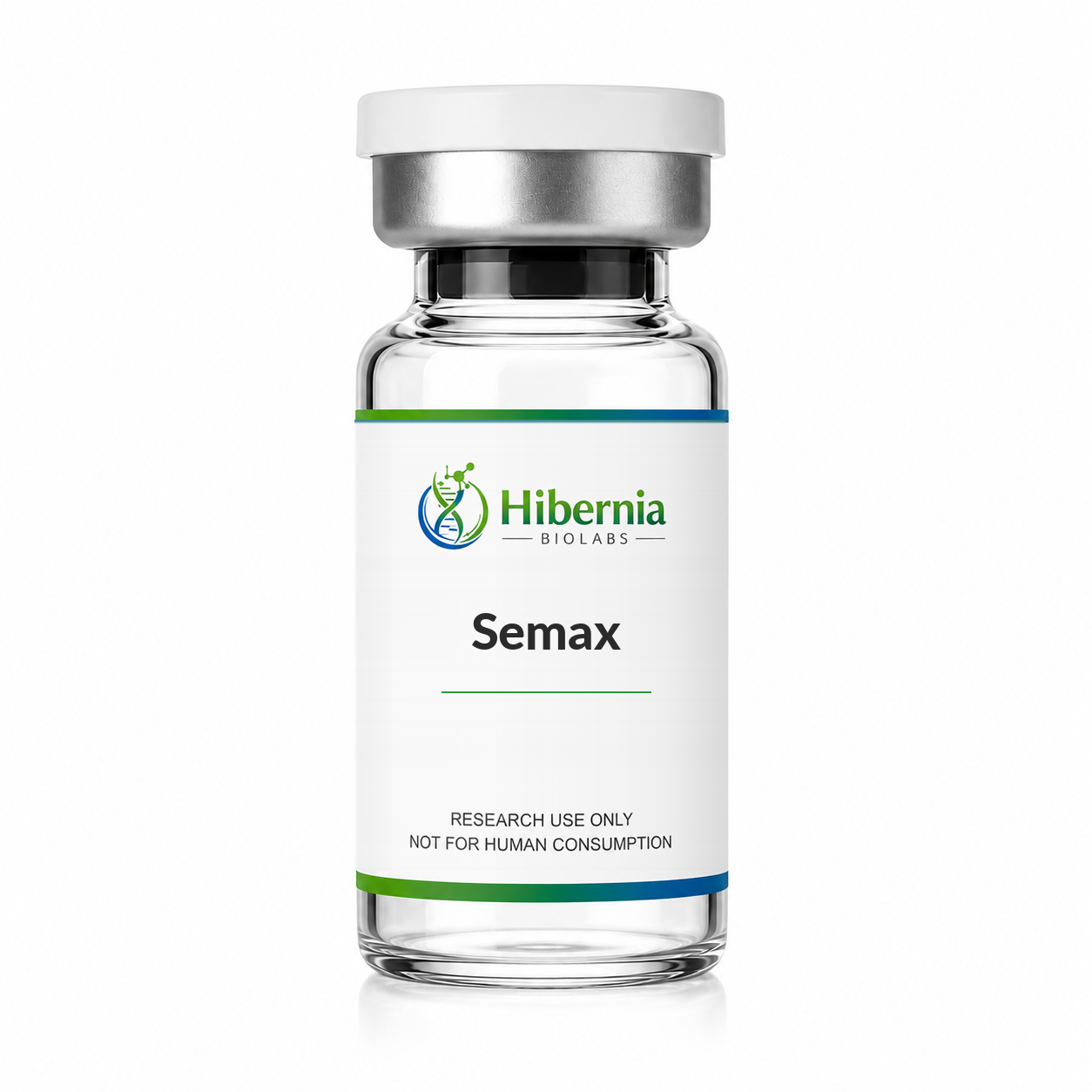
Semax – research-grade investigational peptide
Semax is a synthetic heptapeptide with the amino-acid sequence Met-Glu-His-Phe-Pro-Gly-Pro, commonly described as ACTH(4–7)PGP. It combines an adrenocorticotropic hormone-derived fragment with the Pro-Gly-Pro tripeptide. Because of this structure, Semax is discussed in scientific research involving neurotrophic signalling, gene-expression regulation and cellular responses within the nervous system.
Within laboratory and preclinical research contexts, Semax is of interest due to studies examining its influence on brain-derived neurotrophic factor, commonly known as BDNF, and associated Trk receptor pathways. This makes it relevant for experimental research involving neuronal signalling, cerebral ischaemia models, neuroinflammatory responses and adaptive cellular mechanisms.
Research relevance of Semax
Semax is commonly associated with:
- Investigation of BDNF and neurotrophin-related signalling
- Studies involving Trk receptor activation and gene expression
- Experimental analysis of cerebral ischaemia and reperfusion models
- Research into neuroinflammatory and cellular stress responses
- Investigation of neuronal plasticity, learning and memory-related pathways
Scientific research background
Scientific studies examining Semax have investigated changes in the expression of BDNF, nerve growth factor and their associated receptors. Animal studies using cerebral-ischaemia models have also examined its influence on neuroinflammatory pathways, gene transcription, protein expression and cellular responses following experimental neurological injury.
Some small and predominantly older clinical studies have investigated Semax in neurological research settings. However, the overall human evidence remains limited, and much of the available mechanistic evidence is derived from laboratory and animal models. Results depend on the peptide form, experimental model, concentration, research conditions, methodology and measured endpoints.
These findings should not be interpreted as confirmed therapeutic outcomes in humans. The FDA has identified limited safety information for Semax and has noted potential concerns involving peptide aggregation, peptide-related impurities and immunogenicity. In July 2026, the FDA proposed that Semax free base and Semax acetate not be included on its 503A Bulks List for pharmacy compounding.
Scientific reference
Dolotov OV et al. Semax, an analog of ACTH(4–10) with cognitive effects, regulates BDNF and trkB expression in the rat hippocampus. Brain Research, 2006.
FOR RESEARCH USE ONLY
IMPORTANT INFORMATION
- This substance is supplied strictly for laboratory research purposes.
- It is not a food product.
- It is not a dietary supplement.
- It is not an authorised medicinal product.
- It is not intended for human or animal consumption.
- It is not intended for injection, nasal administration or oral administration.
- The product name does not by itself confirm its identity, sequence, concentration, purity or sterility.
- Keep out of reach of children.
- Keep the container sealed when not in use.
- Store in the original container only.
- Store according to the conditions stated on the product label or certificate of analysis.
- Protect from moisture, excessive heat and direct sunlight.
- Avoid handling during pregnancy or breastfeeding.
In the event of accidental exposure, irritation, illness or any adverse reaction, seek medical advice.


Reviews
There are no reviews yet.