
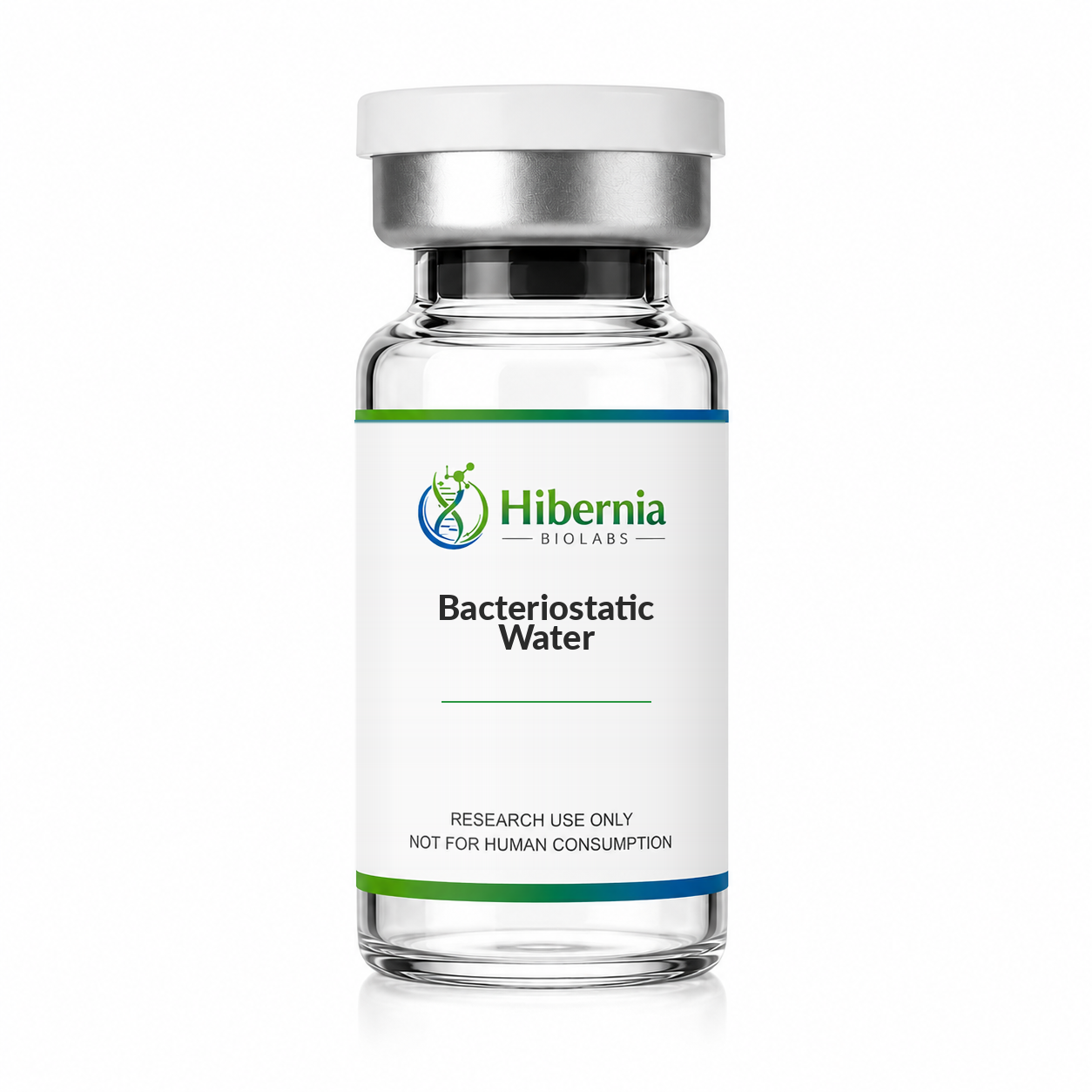
Description
Bacteriostatic Water – research-grade laboratory diluent
Bacteriostatic water is an aqueous diluent commonly formulated with 0.9% benzyl alcohol as a bacteriostatic preservative. The preservative helps inhibit bacterial growth within the container, making the preparation relevant to controlled laboratory procedures involving repeated withdrawals.
Within laboratory research contexts, bacteriostatic water may be used as a vehicle for dissolving or diluting compatible research materials. It does not contain an active peptide or research compound and should only be used where compatibility with the material being studied has been established.
Laboratory relevance of Bacteriostatic Water
Bacteriostatic water is commonly associated with:
- Controlled dilution of compatible laboratory materials
- Reconstitution of compatible research compounds
- Preparation of research solutions at defined concentrations
- Laboratory procedures requiring repeated vial withdrawals
- Vehicle-control and formulation-compatibility studies
Scientific and laboratory background
Commercial Bacteriostatic Water for Injection, USP is described as water for injection containing benzyl alcohol as a bacteriostatic preservative and supplied in a multiple-dose container. Common formulations contain 0.9% benzyl alcohol, equivalent to 9 mg/mL. The presence of a bacteriostatic preservative does not eliminate the need for appropriate aseptic laboratory technique.
Compatibility depends on the specific research material, concentration, formulation, storage conditions and experimental methodology. Some compounds may be incompatible with water or with solutions containing benzyl alcohol.
Scientific reference
DailyMed. Bacteriostatic Water for Injection, USP — Prescribing Information.
FOR RESEARCH USE ONLY
IMPORTANT INFORMATION
- This substance is supplied strictly for laboratory research purposes.
- It is not a food product.
- It is not a dietary supplement.
- It is not intended for human or animal consumption.
- It is not intended for direct administration.
- Do not use unless the solution is clear and the container seal is intact.
- Do not use if visible particles, cloudiness or discolouration are present.
- Use appropriate aseptic laboratory procedures during every vial entry.
- Do not assume compatibility with any research material.
- Keep out of reach of children.
- Keep the container sealed when not in use.
- Store in the original container only.
- Store according to the temperature stated on the product label or certificate of analysis.
- Protect from contamination, excessive heat and direct sunlight.
- Avoid handling during pregnancy or breastfeeding.
- Do not use after the stated expiry date.
In the event of accidental exposure, irritation, illness or any adverse reaction, seek medical advice.


Reviews
There are no reviews yet.