
Description
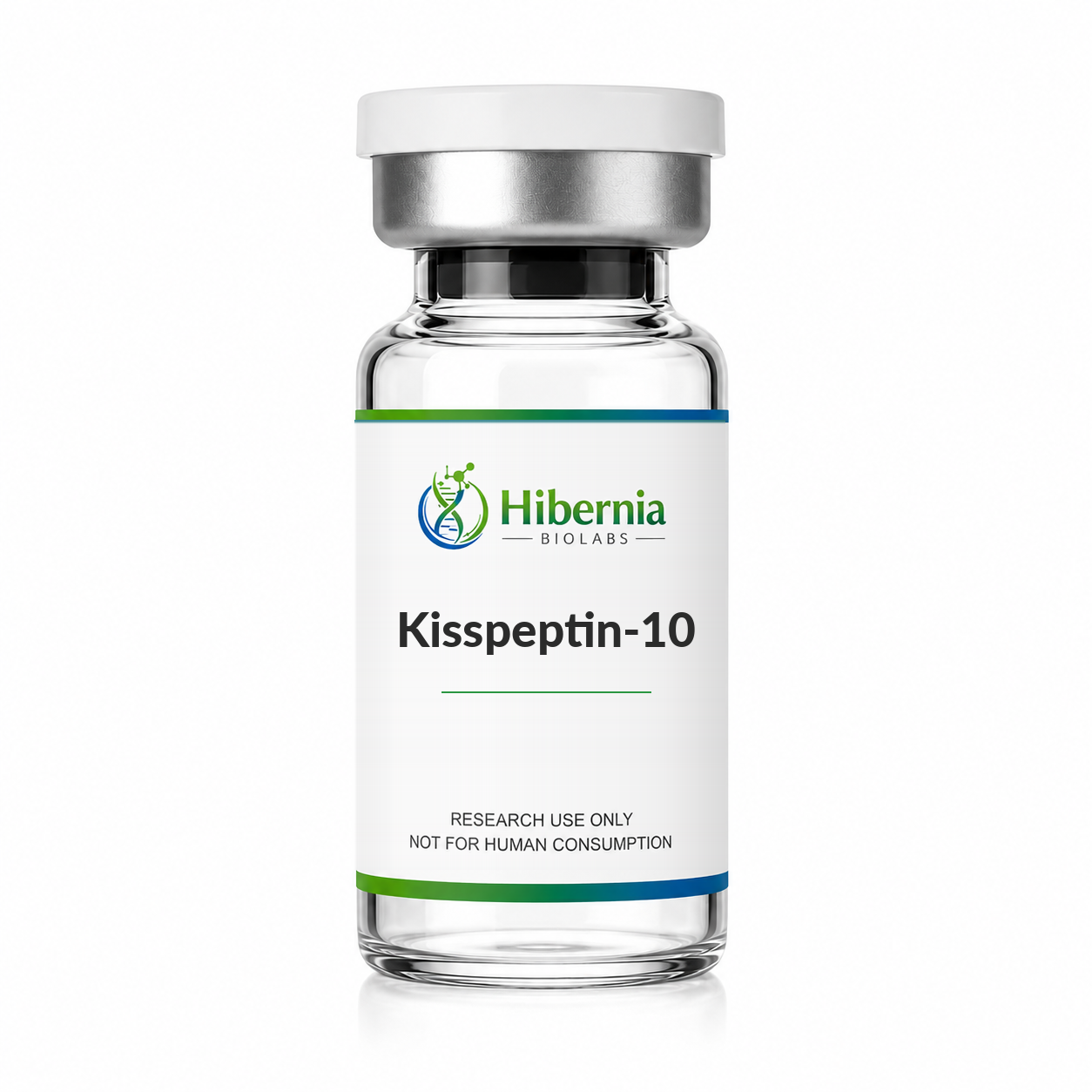
Kisspeptin-10 – research-grade investigational peptide
Kisspeptin-10, commonly abbreviated as KP-10 or Kp-10, is a synthetic decapeptide corresponding to the biologically active C-terminal region of kisspeptin. Its amino-acid sequence is Tyr-Asn-Trp-Asn-Ser-Phe-Gly-Leu-Arg-Phe-NH₂. Kisspeptin peptides are derived from the KISS1 gene and act as natural ligands for the kisspeptin receptor, known as KISS1R or GPR54.
Because of its receptor activity, Kisspeptin-10 is widely discussed in scientific research involving hypothalamic signalling, gonadotropin-releasing hormone regulation and the hypothalamic–pituitary–gonadal axis. It is relevant to studies examining reproductive-endocrine signalling, hormone-release patterns and the cellular mechanisms associated with puberty and reproductive function.
Research relevance of Kisspeptin-10
Kisspeptin-10 is commonly associated with:
- Investigation of KISS1R/GPR54 receptor signalling
- Studies involving gonadotropin-releasing hormone pathways
- Experimental analysis of luteinising hormone and follicle-stimulating hormone release
- Research into puberty and reproductive-endocrine regulation
- Investigation of hypothalamic–pituitary–gonadal axis activity
Scientific research background
Scientific studies examining Kisspeptin-10 have investigated its ability to activate KISS1R and stimulate upstream reproductive-endocrine pathways. Kisspeptin signalling acts on gonadotropin-releasing hormone neurons, which can subsequently influence the release of luteinising hormone and follicle-stimulating hormone from the pituitary gland.
Controlled human research has reported that Kisspeptin-10 can influence gonadotropin secretion. However, observed responses may vary according to sex, menstrual-cycle phase, hormonal status, administration pattern and study population. Continuous or repeated exposure may also produce different responses from short-term experimental exposure.
The available research does not establish independently supplied Kisspeptin-10 as a safe or effective treatment. Results depend on the exact peptide sequence, amidation status, concentration, formulation, experimental model, research conditions, methodology and measured endpoints. These findings should not be interpreted as confirmed therapeutic outcomes or medical claims.
Scientific reference
George JT et al. Kisspeptin-10 Is a Potent Stimulator of LH and Increases Pulse Frequency in Men. The Journal of Clinical Endocrinology & Metabolism, 2011.
FOR RESEARCH USE ONLY
IMPORTANT INFORMATION
- This substance is supplied strictly for laboratory research purposes.
- It is not a food product.
- It is not a dietary supplement.
- It is not an authorised medicinal product.
- It is not intended for human or animal consumption.
- It is not intended for injection, nasal administration or oral administration.
- The product name does not by itself confirm its identity, sequence, amidation status, concentration, purity or sterility.
- Keep out of reach of children.
- Keep the container sealed when not in use.
- Store in the original container only.
- Store according to the conditions stated on the product label or certificate of analysis.
- Protect from moisture, excessive heat and direct sunlight.
- Avoid handling during pregnancy or breastfeeding.
In the event of accidental exposure, irritation, illness or any adverse reaction, seek medical advice.


Reviews
There are no reviews yet.